
She Thought Buy Now Pay Later Was Helping Her, Until It Nearly Cost Her Everything
Share this story
Practical, Or So She Thought
Emily Carter never thought she was bad with money.
She wasn't the kind of person who maxed out credit cards on luxury handbags or booked expensive vacations she couldn't afford. She didn't chase flashy cars, designer clothes, or the latest smartphone every year.
She was practical.
At least, that's what she kept telling herself.
At twenty-six, Emily lived alone in a modest apartment in Seattle, Washington. Rain tapped against her windows for what felt like half the year, and the small apartment had slowly become her sanctuary. A secondhand couch sat beneath the living room window. A tiny kitchen overlooked the street below. Her work desk, assembled from IKEA pieces she'd bought years earlier, faced a wall decorated with framed artwork she'd designed herself.
She worked as a freelance UI designer, building websites and mobile apps for small businesses across the country.
Some months were fantastic. Other months were terrifying.
One client might pay $5,000 in a week, while the next month she'd stare at her banking app wondering whether another invoice would arrive before rent was due.
Freelancing had taught her one lesson very quickly.
Income wasn't predictable. Bills were.
Still, she'd always managed.
She cooked at home, skipped expensive nights out, and carefully built an emergency fund that had slowly grown to nearly four thousand dollars.
It wasn't much. But it helped her sleep at night.
That feeling disappeared on an ordinary Thursday evening.
Just $70 Today
Emily had been struggling with an aging drawing tablet for months.
The screen flickered. The stylus disconnected every few minutes. Twice that week she'd lost client work because the device froze mid-project.
Replacing it wasn't really optional anymore.
She found the exact model she needed online.
$280.
She stared at the total.
Her checking account could technically cover it, but doing so would leave almost nothing for groceries, gas, or next month's utilities.
Then she noticed a cheerful little message beneath the checkout button.
Buy Now. Pay Later.
Just $70 today. No interest. Four easy payments.
It almost felt responsible.
Instead of draining her account, she'd keep most of her cash while still getting the tool she needed for work.
She clicked Confirm Purchase without another thought.
The package arrived two days later. The tablet worked perfectly. The first payment disappeared from her account so quietly she barely noticed it.
Life went on. Nothing bad happened.
And that's exactly why the next decision became so easy.
Twenty Decisions
A few weeks later, Seattle's cold autumn rain settled in.
Emily realized her old winter jacket leaked whenever she walked more than ten minutes.
She found a warm waterproof coat online.
Ninety-six dollars. Or, twenty-four dollars today.
Buy Now. Pay Later.
Again.
A month after that, she bought noise-canceling headphones because construction crews started renovating the building next door.
Then came a standing desk attachment. A coffee machine she'd been eyeing for months. A set of ceramic dishes she'd seen in an interior design video.
None of the purchases felt reckless. Each payment was tiny.
Twenty dollars. Thirty-five dollars. Fifteen dollars. Barely enough to notice.
The problem wasn't one purchase.
It was twenty.
Emily's apartment slowly transformed.
Friends complimented her beautiful coffee station. They admired her workspace.
"Your place looks amazing," one of them said during a movie night.
Emily smiled. "It finally feels like an adult apartment."
She meant it. Everything looked organized. Stylish. Comfortable. Successful.
What nobody could see was the invisible price tag attached to every corner of the room.
Every lamp. Every shelf. Every gadget. Every decorative pillow.
Each one carried another payment scheduled for some future Friday.
A future version of Emily would deal with it.
By December, her phone buzzed constantly.
Payment processed. Upcoming installment due. Reminder: Payment scheduled tomorrow.
She ignored most of them.
After all, they were only twenty dollars. Or thirty. Or forty.
Individually, none of them seemed important.
Collectively, they were becoming something else entirely.
Nearly Forty Percent Gone
The real trouble arrived after New Year's.
One of Emily's largest clients emailed her with unexpected news.
The company was restructuring. All freelance contracts were being paused indefinitely.
Just like that, nearly forty percent of her monthly income disappeared.
She wasn't panicking. Not yet.
She figured another project would replace it soon. It always had before.
Except this time, nothing came.
One week became two. Then three.
Her inbox stayed painfully quiet.
Meanwhile, the payments kept arriving exactly on schedule.
Rain or shine. Busy or broke.
The apps didn't care whether clients paid late.
One Sunday afternoon, Emily sat at her kitchen table with a notebook, a calculator, and a growing knot in her stomach.
For the first time, she opened every Buy Now Pay Later app she'd been using.
One after another.
She wrote every balance onto a sheet of paper.
The first number didn't scare her. The second made her uncomfortable. The fifth made her stop writing.
She grabbed her calculator anyway.
When she pressed the equals button,
She froze.
She wasn't looking at a few small payments anymore.
She was staring at more debt than she'd ever imagined carrying.
And that was before rent was due.
The Emergency Fund Hit Zero
Emily didn't sleep much that night.
Every time she closed her eyes, another payment due date flashed through her mind.
January 12. January 18. January 23. January 30.
The numbers blended together until they stopped feeling like dates and started feeling like countdowns.
By morning she had convinced herself it wasn't that bad. More work would come. It always had before.
She made coffee, opened her laptop, and refreshed her inbox.
Nothing. Again. Nothing.
The silence was louder than any notification she'd ever received.
A week later, her emergency fund was gone.
Not because she had spent it recklessly, but because life kept demanding money.
Rent. Electricity. Internet. Health insurance. Software subscriptions. Groceries.
The emergency fund she'd spent nearly three years building disappeared in less than five weeks.
Watching the balance hit zero felt strangely quiet. No dramatic alarm. No flashing warning.
Just a smaller number. Then another.
Until there was nothing left.
February was worse.
One client delayed payment, blaming accounting. Another postponed a website redesign until "later this quarter." A third stopped answering emails altogether.
Emily checked her banking app every morning before getting out of bed. Then again after lunch. Then before falling asleep.
She wasn't checking because she expected money to appear.
She was checking because anxiety had become a habit.
The Buy Now Pay Later apps didn't care.
Every Friday another installment disappeared.
$28. $36. $42. $19.
Each withdrawal looked harmless. Together, they were draining hundreds of dollars every month.
Money she no longer had.
She found herself playing strange games.
If she transferred money from savings at exactly 8:00 a.m., the grocery payment would clear before the furniture installment hit. If one client paid today, maybe she could cover both.
Maybe.
Her life became a spreadsheet of "what if."
She stopped meeting friends for dinner.
"I'm buried in work," she'd text. "Maybe next week."
The truth was much simpler. She couldn't afford a fifteen-dollar burger without wondering which payment might bounce because of it.
Her best friend Ashley invited her to a birthday brunch.
Emily stared at the message for nearly ten minutes before typing the same excuse she'd used three times already.
Sorry... deadline weekend. Rain check?
Ashley replied with a heart emoji.
Emily placed her phone face down. Then sat alone at her kitchen table eating instant ramen.
Her apartment still looked beautiful. The ceramic dishes sat neatly on open shelves. The expensive coffee machine gleamed beside the sink.
Every object reminded her of a different installment.
Instead of comfort, they filled the apartment with guilt.
She couldn't even look at the coffee machine without thinking,
"I'm still paying for you."
The Envelope Under the Door
March arrived with another surprise.
Her landlord slipped an envelope beneath the apartment door.
Nothing dramatic. Just a printed reminder.
Rent overdue. Please submit payment within seven days to avoid additional action.
Emily read it standing in the hallway.
Then read it again.
Her keys slipped from her hand and landed on the hardwood floor with a dull clatter.
She didn't move.
For several minutes she simply stood there, staring at the letter as if reading it often enough might somehow change the words.
That night she couldn't eat. Her stomach felt tied in knots.
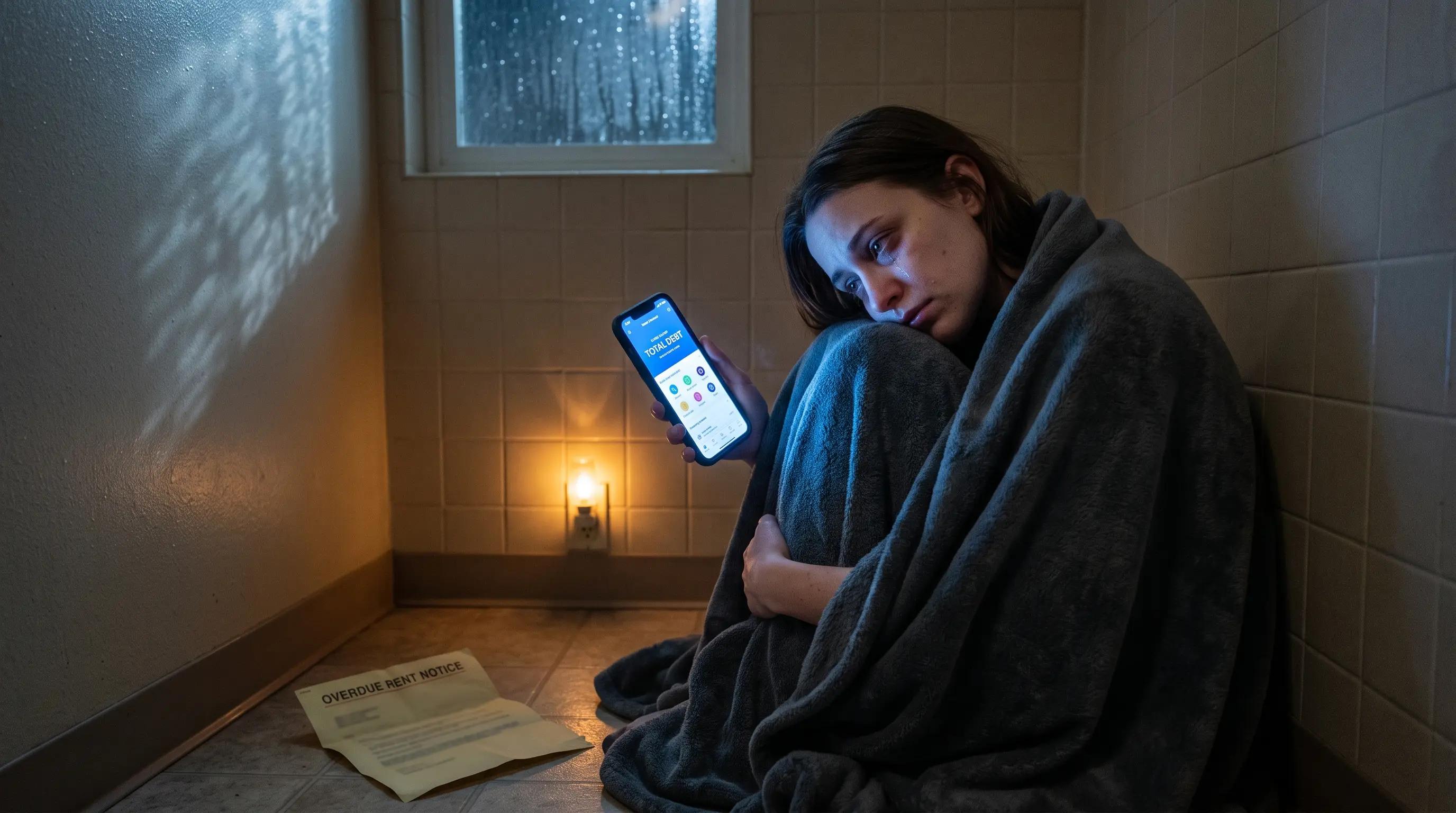
At 2:30 in the morning, she sat on the bathroom floor wrapped in a blanket, surrounded by silence except for the steady rain hitting the window outside.
She opened every payment app again. One by one. Then her credit card. Then her checking account.
She added everything together.
Buy Now Pay Later balances. Credit card debt she'd started using for groceries. Past-due rent.
When the calculator displayed the final number,
She felt sick.
Nearly $5,000.
Not enough to ruin someone else's life.
Enough to completely overwhelm hers.
She buried her face in her hands.
For the first time in months, she cried.
Not loudly. Not dramatically.
Just quietly.
The kind of tears that come after pretending you're okay for far too long.
Have you ever sat alone at two in the morning doing math you'd been avoiding for months, terrified of the number but more terrified of not knowing it? Emily had been running from that number for almost a year. The floor of her bathroom was where it finally caught up with her.
The Phone Call at 3:00 a.m.
Around 3:00 in the morning, she picked up her phone.
She scrolled through her contacts until she found her older brother.
Ryan.
They weren't especially close. He lived outside Denver with his wife and two kids. They talked every few weeks. Mostly birthdays. Mostly holidays. Mostly about nothing important.
Her thumb hovered over his name.
Then she pressed Call.
He answered on the fifth ring.
"...Emily?" His voice sounded half asleep. "Everything okay?"
She tried to answer. Nothing came out. Only a shaky breath.
Ryan immediately sat up.
"Emily... what's wrong?"
For nearly half an hour, she told him everything.
The tablet. The jacket. The headphones. The coffee machine. The installments. The missed client payments. The overdue rent. The panic attacks. The sleepless nights. The lies she'd been telling everyone.
Ryan barely interrupted.
He simply listened.
When she finally stopped talking, neither of them spoke for almost a minute.
Finally he broke the silence.
"You know..." His voice was calm. "I've never told anyone this."
Emily wiped her eyes. "What?"
"When I was twenty-four, I buried myself in credit card debt."
She blinked. "You?"
"I owed almost twelve grand."
Emily sat frozen.
Ryan? The responsible one? The guy who always seemed to have everything figured out?
"I spent two years digging myself out," he continued. "It was the hardest thing I've ever done."
"You never told me."
"I was embarrassed."
Another silence.
Then Ryan asked the question that changed everything.
"Can you open your laptop?"
Emily looked toward the living room. "...Why?"
"Because tonight we're going to stop guessing."
The Spreadsheet
For the next hour, they built a spreadsheet together.
Every installment. Every due date. Every credit card balance. Every monthly bill.
Nothing hidden. Nothing ignored.
When they finally reached the bottom, the total stared back at them.
Emily leaned back in her chair.
Seeing the numbers organized in one place was terrifying.
But somehow, it also felt different.
For months the debt had been a monster hiding in the dark.
Now it had a shape. A number. A plan.
Ryan looked at the spreadsheet before speaking again.
"I can help you catch up on rent."
Emily immediately shook her head. "No."
"It's not charity."
"I can't ask you."
"I'm not giving it to you." He smiled. "I'm lending it to you."
She looked down.
"You'll pay me back. But first," he pointed toward the screen, "we fix the reason you got here."
Emily stared at the spreadsheet for a long moment.
Then slowly nodded.
For the first time in months, she didn't feel trapped.
She felt scared.
But she also felt something else.
Hope.
The Cardboard Box
Ryan transferred the money the following morning.
Just enough to cover Emily's overdue rent. No more. No less.
When the notification appeared on her phone, she didn't feel relieved.
She felt responsible.
For the first time, someone else's trust was attached to her financial decisions.
She promised herself she wouldn't waste it.
The next morning, Emily walked through her apartment with a cardboard box.
She stopped in front of the standing desk converter. The one she'd convinced herself would make her more productive. It had spent more time collecting dust than supporting her monitor.
She unplugged it. Set it in the box.
Next came the expensive coffee machine. She had dreamed about owning it for months. Now it only reminded her of another payment she'd struggled to make.
The ceramic dishes followed. Then the weighted blanket she'd used twice. The Bluetooth speaker. The extra monitor stand. The designer backpack she bought because it "looked professional."
Each item carried a memory.
Not of happiness.
Of justification.
"I deserve this."
"I'll barely notice the payments."
"It's only twenty dollars today."
Now every object carried a different message.
"You couldn't actually afford me."
That weekend she listed everything online.
Marketplace. Craigslist. Local community groups.
The first buyer never showed up. The second wanted half the asking price.
Emily almost refused. Then she remembered why she was selling.
She accepted.
Sixty dollars in cash felt strangely satisfying.
Not because it solved anything.
Because it represented movement. Forward.
By the end of the week she'd sold nearly half the items she'd purchased over the previous eight months.
Every dollar went into one place.
Not shopping. Not savings.
Debt.
Ryan's Sunday Texts
Ryan checked in every Sunday.
No lectures. No guilt.
Just one simple text.
Spreadsheet?
At first Emily hated it. It felt like homework. Like reporting to a teacher.
But after a few weeks, she found herself looking forward to it.
Each Sunday the numbers were slightly smaller. Each Sunday another balance disappeared.
Tiny victories. But victories all the same.
The Coffee Shop on the Corner
She also made another decision. One that hurt her pride more than anything else.
She took a part-time job.
Three evenings a week at a neighborhood coffee shop just six blocks from her apartment.
She hadn't worked behind a counter since college. The pay wasn't exciting. The work wasn't glamorous.
But every Friday she walked home knowing exactly how much money would hit her account the following week.
No waiting for invoices. No chasing clients. No wondering.
Predictable income felt like medicine.
Her freelance business slowly stabilized.
Instead of saying yes to every project that came along, she became more selective. She required deposits before starting large jobs. She followed up on unpaid invoices sooner. She stopped treating late-paying clients like they were doing her a favor.
For the first time since graduating, she started treating her freelance work like a real business.
One Down. Three to Go.
The months passed quietly.
April. May. June.
No dramatic breakthroughs. No lottery tickets. No surprise inheritances.
Just ordinary days filled with ordinary discipline.
Some mornings she still wanted to click the familiar button at checkout.
Pay in 4.
The words appeared almost everywhere she shopped online. New clothes. Electronics. Furniture. Even groceries.
The option always looked harmless. Convenient. Friendly.
She noticed something she'd never seen before.
The payment button was always large. Bright. Easy to find. The full price was usually much smaller. Almost hidden.
Once you recognize a trap, it's difficult to stop seeing it.
By late summer, the first Buy Now Pay Later account reached zero.
Emily stared at the confirmation screen longer than she expected.
One down. Three to go.
She smiled for the first time in weeks.
Not because the journey was over.
Because it finally felt possible.
Balance Paid in Full
October arrived almost exactly one year after she'd purchased the drawing tablet that started everything.
She made the final payment on her last installment plan.
Thirty-one dollars.
The smallest payment she'd made all year. The most satisfying one.
The app displayed a cheerful green checkmark.
Balance Paid in Full.
She didn't celebrate. She simply held the phone for a moment.
Then pressed Delete App.
One after another, every Buy Now Pay Later app disappeared from her home screen.
The silence afterward felt peaceful.
She still owed Ryan money. But that debt felt different.
It wasn't hidden behind glossy marketing or clever checkout buttons. It came with honest conversations. Monthly payments they both understood.
And every payment brought them closer to zero. Not farther away.
Six months later, she mailed him the final transfer.
A few seconds later, her phone buzzed.
Ryan: Proud of you.
A minute later, another message arrived.
Ryan: Now promise me one thing.
Emily smiled before replying.
What's that?
His answer came almost immediately.
Ryan: Never finance a want. Save first. Buy later. Peace of mind is worth the wait.
She read the message twice.
Then saved it.
$3.25
These days, Emily still shops online. She still fills her cart sometimes. She still feels the excitement of imagining something new arriving at her door.
But before she clicks Buy, she asks herself one question.
"Could I pay for this today without borrowing from my future?"
If the answer is yes, she buys it without guilt.
If the answer is no, she closes the tab.
Surprisingly, most of the time she never thinks about the item again.
It turns out she hadn't wanted many of those things.
She had simply wanted the feeling they promised.
Comfort. Success. Security.
But none of those ever arrived in a cardboard box.
A year after deleting the apps, Emily walked past the same coffee shop where she'd once worked evenings to pay off her debt.
She ordered a simple black coffee.
The barista handed it over with a smile.
"$3.25."
Emily tapped her debit card.
Not because she had to split the payment.
Because she could afford it.
She carried the warm cup outside and watched the Seattle rain fall across the quiet street.
For the first time in a very long time, she wasn't calculating due dates. She wasn't moving money between accounts. She wasn't wondering which payment would hit first.
She simply stood there, enjoying a cup of coffee she had already paid for.
And somehow, it tasted better than anything she'd ever bought in four easy payments.
Before You Go
The most dangerous financial mistakes rarely begin with reckless decisions.
They begin with convenient ones.
Buy Now Pay Later isn't automatically harmful. For some people, it can be a useful tool when managed carefully. But convenience can make spending feel painless, and painless spending often becomes invisible spending.
Emily didn't lose control overnight.
She lost it one small payment at a time.
The good news is that she found her way back exactly the same way.
One budget. One payment. One better decision at a time.
If you're feeling overwhelmed by debt or wondering where your paycheck disappears every month, remember this.
Being in debt isn't a life sentence.
It's a situation.
And situations can change.
Sometimes the first step isn't earning more money.
It's simply deciding that your future deserves more than another easy payment plan.
Did this story make you look at your own checkout screen differently? Share it with someone who needs to read it today.
Share this story
More in Addiction Recovery